Residential case · Synthetic plan
Before changing a room, test the explanation
An interest in the traditional reading is a good starting point. Deciding whether to change a bedroom takes another step: identify the actual concern, the evidence available and the cost of being wrong.
The current recommendation
What is actually available
- Source
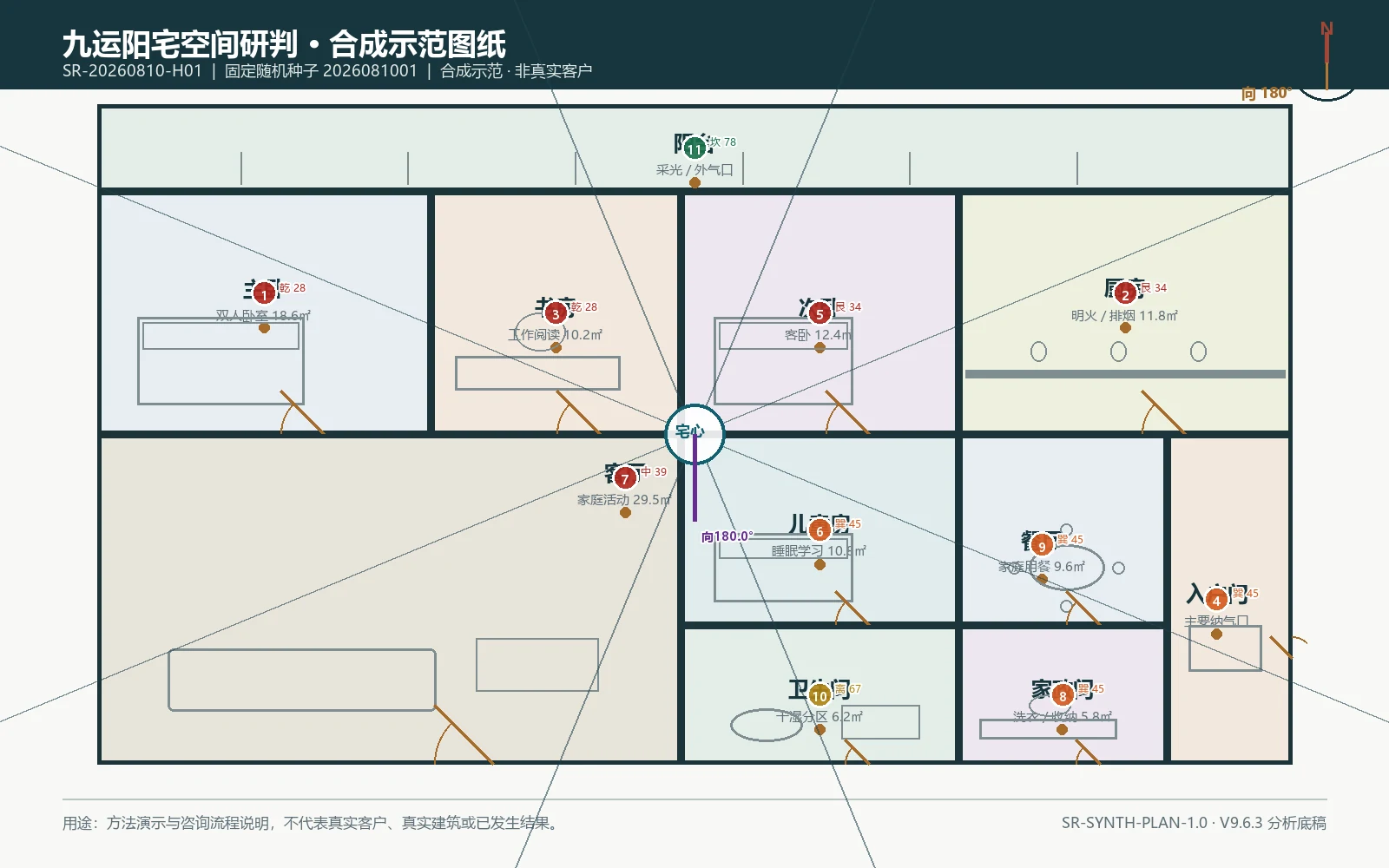
- Sanrui example SR-20260810-H01, published in August 2026.
- Stated inputs
- 2024 occupancy, period 9; sitting Zi at 0°, facing Wu at 180°; analysis year 2026; synthetic drawing seed 2026081001.
- Recorded method
- Sanrui Xuan Kong V9.6.3; the published example assigns label representative points to sectors using the drawing centre.
- Verification status
- This page summarises the published inputs and historical output. It is not a new calculation, an on-site measurement or an independently verified performance test.
Read the chart without inventing a result
| Sector | Period / mountain / facing / annual | Original model score |
|---|---|---|
| 乾 Qian | 1 / 4 / 5 / 2 | 28 |
| 艮 Gen | 3 / 2 / 7 / 4 | 34 |
| 坎 Kan | 5 / 9 / 9 / 6 | 78 |
In that historical output, Qian and Gen were placed earlier in the model’s review order. This preserves what the software reported; it does not establish a reason for a resident’s sleep, mood or relationships. The weights and chart interpretation are method choices, not clinical measurements.
The practical translation is a question: who uses this room, for how long, and is any relevant disturbance documented? Check all actual hazards across the property, including the higher-scoring sectors. A model ranking must never decide the safety inspection order.
Compare the options before acting
| Option | Reason to consider it | Limit |
|---|---|---|
| Keep the room as-is | No verified issue, or insufficient comparable observations | Still act promptly on a real safety or health concern |
| Change one non-structural arrangement | A specific, observed light or circulation issue, with resident agreement | Do not alter several things at once and then claim to know the cause |
| Seek relevant assessment | A health, building, electrical or gas concern requires expertise | A cultural reading cannot provide that diagnosis or approval |
| Change room or move home | Only after comparing actual needs, disruption and costs | Not supported merely by the historical model score |
What could overturn the explanation?
- The issue predates the move, occurs in other rooms or persists away from the property. The claim of a single room-based cause weakens.
- The orientation, centre or representative point is wrong. The recorded sector assignment must be revisited before interpretation.
- No comparable change follows the limited adjustment, or disruption gets worse. Reassess or reverse it rather than adding more objects.
- A different cause is established through appropriate assessment. That finding takes precedence over a cultural explanation.
Assumptions and longer-term costs
Any trial assumes the residents agree, access remains safe and the relevant conditions can be recorded. Permission, cost and room use may differ from the drawing. A label point is not the entire room boundary, and a historic chart is not a current survey.
Repeated furniture moves can disrupt routines, displace another resident and reinforce anxiety about ordinary rooms. Agree one review occasion and a limit on effort. Do not buy recurring adjustments just because the annual chart changes.
A review record, not a success claim
- Baseline
- The actual concern, dates, room use and relevant observations before the change. There is no resident baseline in this synthetic example.
- Review
- Use the same definition and note work schedules, travel or other changes. A small before/after difference is not proof of a traditional cause.
- Stop
- Stop an unsafe or unwanted adjustment. If sleep problems persist or affect daily life, seek appropriate medical advice without waiting for a reading or review date.
Health reference: NHS: insomnia. This source supports the referral boundary, not the effectiveness of Xuan Kong.